This is chapter 1 of the Context Cookbook — the full thing is a paid book that walks you through building a personal context vault and the agents that run on top of it. Chapter 1 is free for a reason. It's the only chapter that matters if you never buy the rest: the ninety-minute workflow that produces your first ten structured DOTs and the retrieval rule that makes them useful the same day.
You do not need the Dots platform to do this. You need a notes app that can hold markdown, any decent AI model, and the ability to sit still for ninety minutes. A yellow legal pad would also work. Structure is the product; the tools are replaceable.
Before You Start
Two things you need to accept before you begin, or the workflow will not take.
The First-Day Workflow
Seven tasks. Ninety minutes. One vault.
- Commit to the file structure. (5 min)
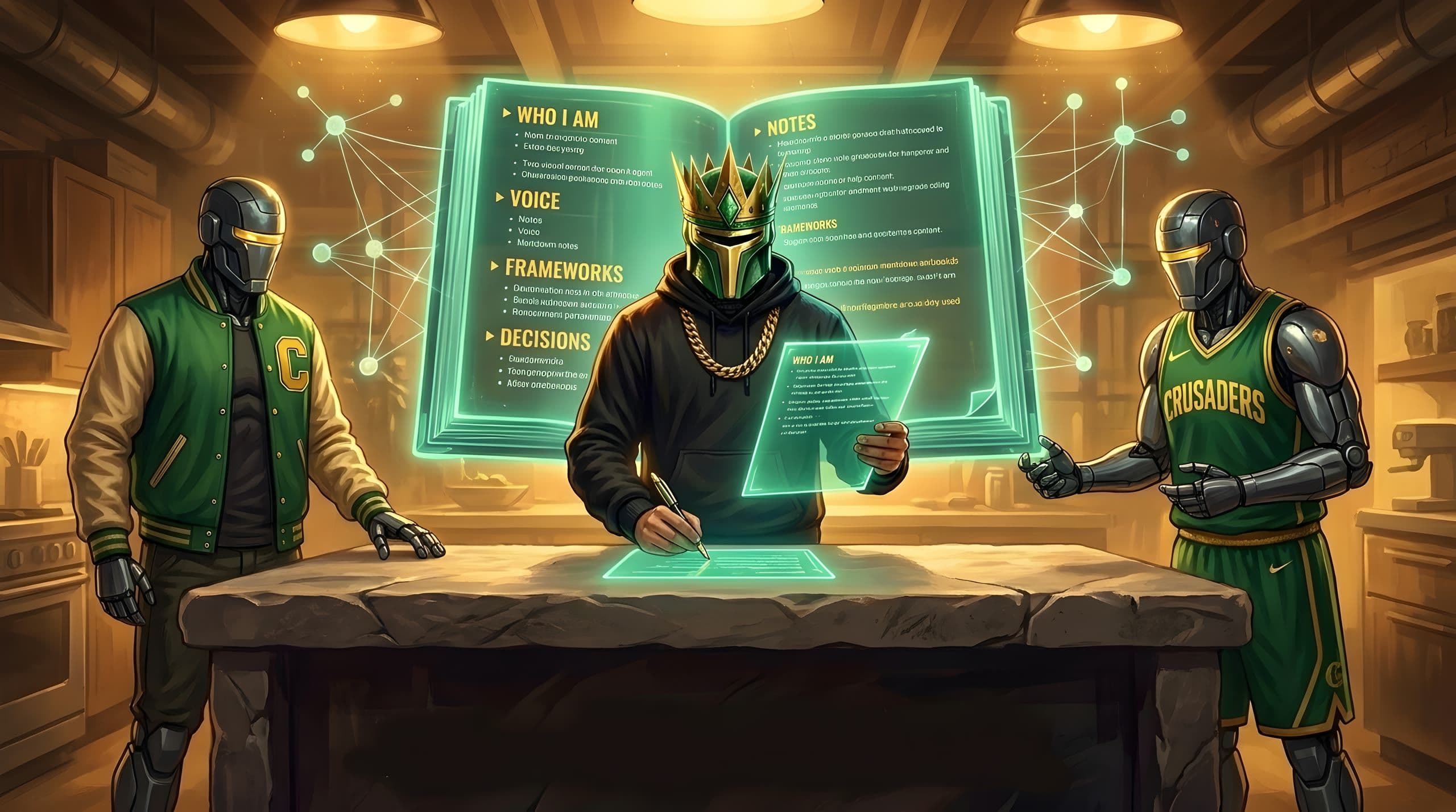
- Write your Who I Am DOT. (10 min)
- Capture your Voice in three examples. (15 min)
- List your top three frameworks. (15 min)
- Log the ten most recent non-trivial decisions. (20 min)
- Tag everything by DIIICE. (10 min)
- Run the retrieval test. (15 min)
Do them in order. You can't run the retrieval test before you have anything to retrieve, and you can't tag anything before you've written it. The order is the workflow.
Task 1: Commit to the File Structure (5 min)
Open your notes app. Create one folder called vault. Inside it, six subfolders — one per DIIICE type:
vault/
  data/            # facts, tables, enumerations, schemas
  intelligence/    # compressed judgments, patterns, rules of thumb
  instructions/    # procedures, "do X then Y"
  ideas/           # hypotheses, "maybe we should try X"
  context/         # who, why, history, constraints, taste
  examples/        # samples of the thing itself — voice, style, layout
Don't overthink the filesystem. The point of the six folders is to force a decision every time you add a file. The folder you drag it into is the DIIICE tag you're committing to. If you catch yourself hovering between two folders for more than ten seconds, you've got a compound thought — split it into two files.
Task 2: Write Your Who I Am DOT (10 min)
File: context/who-i-am.md. Six lines. These six:
- Name and age.
- Where you live.
- What you do for money (ten words or less).
- What you're secretly working on.
- One non-obvious thing about your taste.
- One line about what you're scared of being wrong about.
Six lines, no more. Not a paragraph. Not six bullet points with sub-bullets. Six lines of six sentences. If you're feeling creative, throw a frontmatter block on top so you can retrieve by metadata:
---
dot_id: CTX-001
diiice: context
title: "Who I Am"
domains: [identity]
---

Name: John Kane, 32.
Home: Las Vegas, originally Philadelphia.
Work: Solo founder of Dots, an AI context infrastructure company.
Secret: I'm writing a book and a song cycle at the same time.
Taste: painterly digital art over photography; direct prose over clever.
Scared of being wrong about: bootstrapping the company past month 18.
Write it. Save it. Move on. Do not edit it twelve times. This is the skeleton; you will re-write it in three months when your life has proven the first draft wrong.
Task 3: Capture Your Voice in Three Examples (15 min)
Find three pieces of your writing that sound like you. An email to a friend, a tweet that performed, a paragraph from something you abandoned. Copy them verbatim — do not edit — into three files under examples/voice/:
examples/voice/
  voice-sample-01.md   # email
  voice-sample-02.md   # tweet
  voice-sample-03.md   # abandoned paragraph
Then write one more file — intelligence/voice-rules.md — with four bullets describing the voice the three examples share. Not who you are. Not what you want the voice to be. Specifically: what habits show up in all three samples, and what the voice would never do. Four bullets. Thirty seconds per bullet.
The Voice DOT is the four bullets. The Examples are the three raw samples. Agents want both. The four bullets give them the rule; the three samples give them the feel. Never ship one without the other.
Context Engineering Paradigm — From Context Extension to Context Curation
This is why we separate voice rules (Intelligence) from voice samples (Examples). Different DIIICE types get retrieved differently by agents. An agent writing a blog post pulls Voice rules + Voice samples + Context — not Data, not Instructions, not Ideas. Curation over extension is the whole game.
Task 4: List Your Top Three Frameworks (15 min)
A framework is any named mental model you actually use to decide things. Three is the floor, not the ceiling. Pick the three that fit the pattern of 'I reach for this every week.'
Each framework is a single file in intelligence/:
---
dot_id: INT-002
diiice: intelligence
title: "DIIICE — The Six-Letter Knowledge Taxonomy"
domains: [context-engineering, knowledge-management]
---

## The Framework
Every piece of knowledge fits into Data, Intelligence, Instructions,
Ideas, Context, or Examples. Choose by role: data is looked up,
intelligence is applied as a filter, instructions are executed,
ideas are surfaced, context is assumed, examples are imitated.

## Why It Exists
Because I kept pasting the same six categories into every prompt
and needed a way to stop typing them out.

## Where I've Used It Recently
- Labeling 49,000 DOTs in the vault
- Splitting Forge's retrieval to Instructions + Context + Examples
- Reviewing a client's knowledge base (they had 4 buckets and kept
  drowning in Context).
Notice the three-section structure. Framework / Why / Where used. Not philosophy, not manifesto, not history-of-the-idea. Framework, why, where. Three sections. Four sentences per section on average. Any more and you've drifted into essay.
Task 5: Log Ten Recent Decisions (20 min)
Open a single file: context/decisions-log.md. Write ten decisions you made in the last ninety days that weren't obvious, and the sentence that justifies each. Example entry:
## 2026-03-14 — Pause inbound sales for Q2
Why: Delivery is the bottleneck, not pipeline.
     Adding clients while delivery is broken makes the bottleneck
     worse and spends the best month of the year on refunds.
     Resume inbound after the operations hire lands.

## 2026-03-22 — Kill the newsletter custom stack; move to Loops
Why: Our list is 1,400 people. Maintaining two weeks of email
     infrastructure per quarter is not worth two cents per email
     of theoretical savings. Loops works, the UI is obvious,
     the analytics are better than what we'd built.
... (eight more)
Ten rows. Ten sentences. No story, no excuse, no context you wouldn't write in front of a junior team member. If you catch yourself hedging or writing 'it's complicated' — trim the hedge. The point of the decisions log is to state the taste you used, so an agent can inherit it. Hedges are lost taste.
Task 6: Tag Everything by DIIICE (10 min)
Go back through the files you just created. Confirm the DIIICE type is in the frontmatter of every one. Confirm the file lives in the matching folder. Fix any mismatches. You'll find two or three — it's always two or three. If you find more than three, you're probably miscategorizing one particular type; almost always it's a file you wrote as Context that should be Intelligence, because Context feels safer and Intelligence feels like you're claiming something.
Task 7: Run the Retrieval Test (15 min)
Open a new chat with any AI model. Paste, in this order:
- Your
who-i-am.md - Your
voice-rules.md(the four bullets) - Two of the three voice samples
- The framework most relevant to the test topic (pick one)
- The three most relevant rows from
decisions-log.md
Then — and only then — paste your request. Something small and real: 'Write a LinkedIn post announcing a new blog post I published today about context engineering.' or 'Draft a response to this client email.' Keep the request to a single sentence.
Compare the output to what you would have gotten from the same model without the context stack. If this exercise is working, the difference will be embarrassing. Your post-with-vault will sound like a decent version of you; your post-without will sound like anyone.
What You Have Now
After ninety minutes:
- One
who-i-am.mdContext DOT. - Three voice Example DOTs + one voice Intelligence DOT.
- Three framework Intelligence DOTs.
- One ten-row decisions-log Context DOT.
- A retrieval habit: load the five relevant DOTs before you ask.
That's a baseline vault. It is extremely small. It is also, already, more than most of your competitors are running.
The rest of the cookbook — chapters 2 through 9 — is the scaling version. How to grow the vault past one hundred DOTs without it turning into a folder of orphans. How to wire multi-agent retrieval so the right DOTs load for the right task automatically. How to turn the decisions log into a pricing DOT, a hiring DOT, a product-spec DOT, and a handful of other specialized artifacts. How to handle conflict when two DOTs disagree. How to archive a DOT you no longer believe. How to build the DOT graph that eventually tells you what you think about the things you've been avoiding thinking about.
But chapter 1 is the chapter you actually need. Everything after it is a refinement. If you never buy another thing I write, do the ninety minutes above, then do them again every Sunday morning for a month. You will end with thirty DOTs. You will end with a working mirror. You will end with an agent that, when you ask it to write for you, writes for you.
The One Rule I'd Tattoo on Your Hand
If you forget everything else in this chapter, remember one rule:
That's chapter 1. Ninety minutes. Seven tasks. Ten DOTs. A retrieval test that embarrasses you. Do it this weekend. The cookbook is available at mydots.ai/cookbook if you want the scaling version, but the cheap version — the one that changes the most for the least effort — is the one you just read.
Coming in chapter 2: why the decisions-log DOT is the single highest-leverage artifact in the entire vault, and the pattern for turning a decisions log into a pricing engine.